
Fundraising ROI is what you raise for each dollar you spend. The sector usually states it the other way round, as the cost to raise a dollar, which is fundraising cost divided by funds raised. A widely quoted rule of thumb puts a reasonable cost at about 20 cents overall, a return of about 5 dollars per dollar spent (Greenfield, The Philanthropist, July 1989). Two adjustments make either number useful for decisions: include staff time, and judge acquisition on what donors give over their lifetime rather than on its first-year ratio.
Key takeaways
- The Association of Fundraising Professionals’ FAQ on evaluating fundraising costs (16 October 2018) says direct mail acquisition may cost 1.00 to 1.25 dollars per dollar raised, and a second mailing to the donors it found only about 20 cents.
- James Greenfield’s reasonable-cost guidelines in The Philanthropist (July 1989) put special events at 50 cents per dollar raised and capital campaigns at 5 to 10 cents, and say mature programs should be able to bring overall costs down to 20 cents.
- Fundraising ROI as return per dollar spent is funds raised ÷ cost, so Greenfield’s 20-cent overall figure (The Philanthropist, July 1989) is a return of about 5 dollars per dollar spent.
Updated October 2026
How to calculate fundraising ROI and cost to raise a dollar
Fundraising ROI (return per dollar spent) = funds raised ÷ fundraising cost
Cost to raise a dollar = fundraising cost ÷ funds raised
They’re the same measure turned over: a cost of 20 cents per dollar raised is a return of 5 dollars per dollar spent. Some sources quote net ROI instead, (funds raised − cost) ÷ cost, which gives 4 on the same figures. This post uses return per dollar spent throughout, and keeps the benchmarks in cents per dollar, as their sources state them.
Calculate it per campaign and for the program overall, over the same period. The arithmetic is the easy part. The decisions are about what goes on each side of the line:
- Costs. Direct costs (print, postage, venue, lists, agency fees) and the staff time spent on the campaign. Then a fair share of the systems it relies on, such as the CRM and payment processing. Leave out a cost and the campaign that used it looks better than it is.
- Income. Cash received, not pledges, in the period you’re measuring. For regular giving, decide how many months of gifts count towards the campaign that recruited the donor, and stick to it.
- Period. A campaign that launched in May and banks most of its income in July spans two financial years. Measure it over both, or it looks expensive in one and free in the next.
A worked example (illustrative figures): a winter appeal spends AUD 18,000 on print, postage and data processing, and takes about AUD 6,000 of staff time. It raises AUD 100,000 in cash. On direct costs alone it costs 18 cents per dollar. With staff time it costs 24 cents, a return of about 4.2 dollars per dollar spent. Both are close to the AFP’s 20 cents for a second mailing to known donors. Only the second is the real cost of the appeal, and only the second compares fairly with an event or a major gifts program.
Benchmarks by fundraising method
Rules of thumb by method, and what to count
| Fundraising method | Cost per dollar raised (return per dollar spent) | Costs to include |
|---|---|---|
| Capital campaigns | 5 to 10 cents (10 to 20 dollars) | Campaign staff and relationship managers’ time, events for prospects, research |
| Direct mail renewal | about 20 cents (second mailing, AFP) (about 5 dollars) | Print, postage, data processing, staff time |
| Special events | about 50 cents (about 2 dollars) | Venue, catering, entertainment, prizes, staff and volunteer coordination time |
| Direct mail acquisition | 1.00 to 1.25 dollars, more than it raises (0.80 to 1.00 dollar) | Lists, print, postage; judge on lifetime value |
| Annual fundraising overall | about 20 cents (about 5 dollars) | Everything above, plus a fair share of CRM and payment costs |
Sources: AFP FAQ on evaluating fundraising costs (16 October 2018) for direct mail; Greenfield, The Philanthropist (July 1989) for events, capital campaigns and the overall figure.
These figures are rules of thumb, not standards. They come from US fundraising practice, and no Australian regulator sets a cost ratio that charities must meet. Read them as a sense check. If your direct mail renewal costs 60 cents per dollar, something is worth a look. If it costs about 20 cents with staff time counted, it’s doing its job.
The spread matters more than any single number. Capital campaigns and major gifts are cheap per dollar because a few relationships bring in large sums. Acquisition is expensive because it buys new donors, not this year’s income. A blended overall figure is only meaningful if you know which methods are in it, so report the overall ratio next to the ratio by method, never on its own.
Why do events look cheaper than they are?
Events usually carry a large hidden cost: the hours staff spend planning, selling tables, finding prizes and coordinating volunteers. Leave that out and an event can look as efficient as an appeal.
Harbourlight Community Services is a fictional charity built on typical sector data. Across its events from July 2024 to June 2026, income was AUD 497,392. Direct costs took AUD 254,300, and staff time another AUD 148,300, leaving AUD 94,792. Its gala dinner costs 56 cents per dollar raised on direct costs alone, close to Greenfield’s 50 cents for events. Counted with staff time, it’s 84 cents. Across all of Harbourlight’s campaigns, staff time is 14.8% of the full cost.
Click a screen to see it full size.
What’s left once staff time is counted?
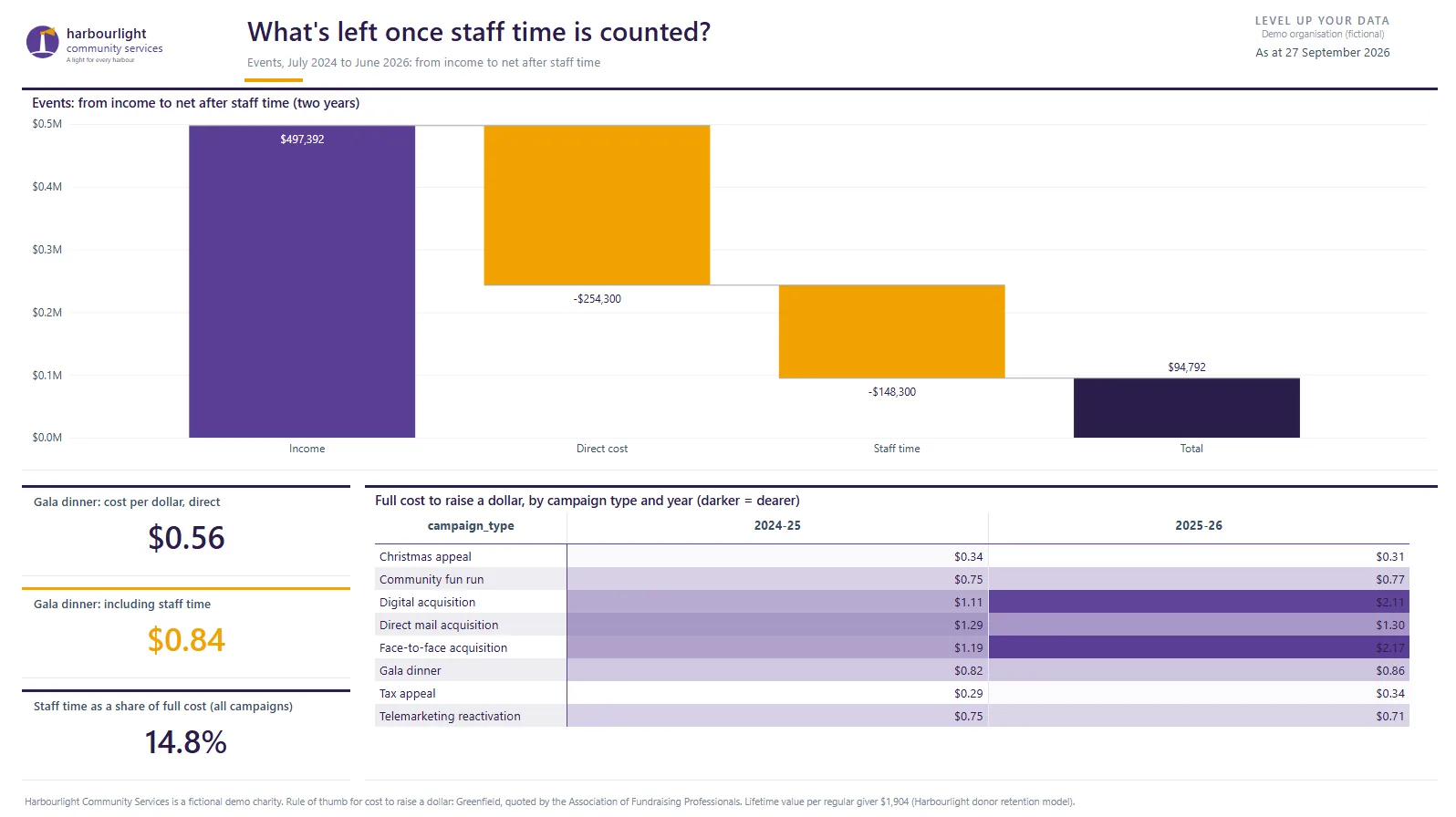
Harbourlight Community Services is fictional; figures are illustrative.
None of this says the gala should go. It may bring in major donors, sponsors or volunteers who matter later. But the board should decide with the full cost in front of it, not the direct cost.
Why does acquisition always look expensive?
Acquisition costs more than it raises in its first year: the AFP’s 1.00 to 1.25 dollars per dollar raised for direct mail acquisition says as much. That’s expected. The return comes from the years a new donor keeps giving, so judge acquisition on lifetime value rather than on its first-year ratio.
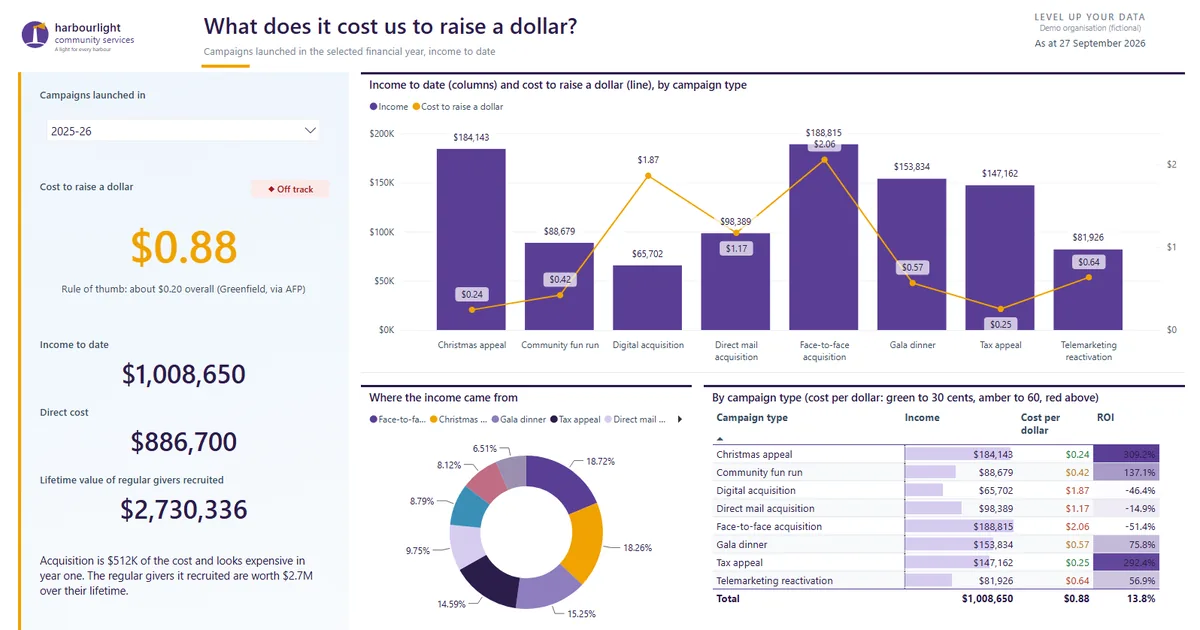
Harbourlight shows the effect. For campaigns launched in 2025-26, its overall cost to raise a dollar on direct costs is 88 cents, against the 20-cent rule of thumb. On direct costs, the Christmas appeal costs 24 cents per dollar and face-to-face acquisition 2.06 dollars. With staff time counted, the full-cost screen above shows 31 cents and 2.17 dollars. Acquisition is about AUD 512,000 of the cost, but the regular givers it recruited are worth AUD 2.7 million over their lifetime.
What does it cost us to raise a dollar?
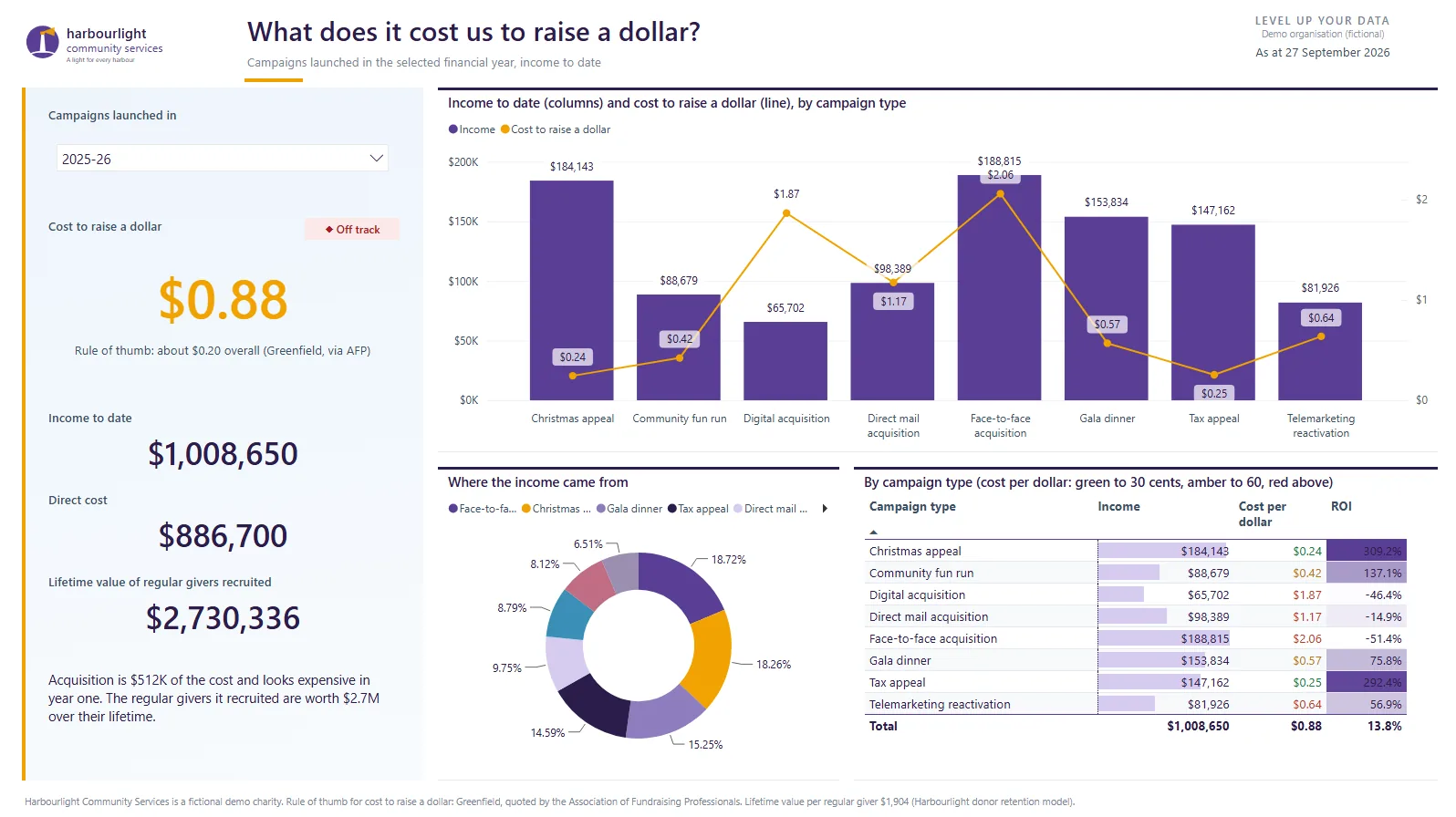
The table’s ROI column is net ROI as a percentage, (income − cost) ÷ cost: the Christmas appeal’s 309% is a return of about 4.1 dollars per dollar spent.
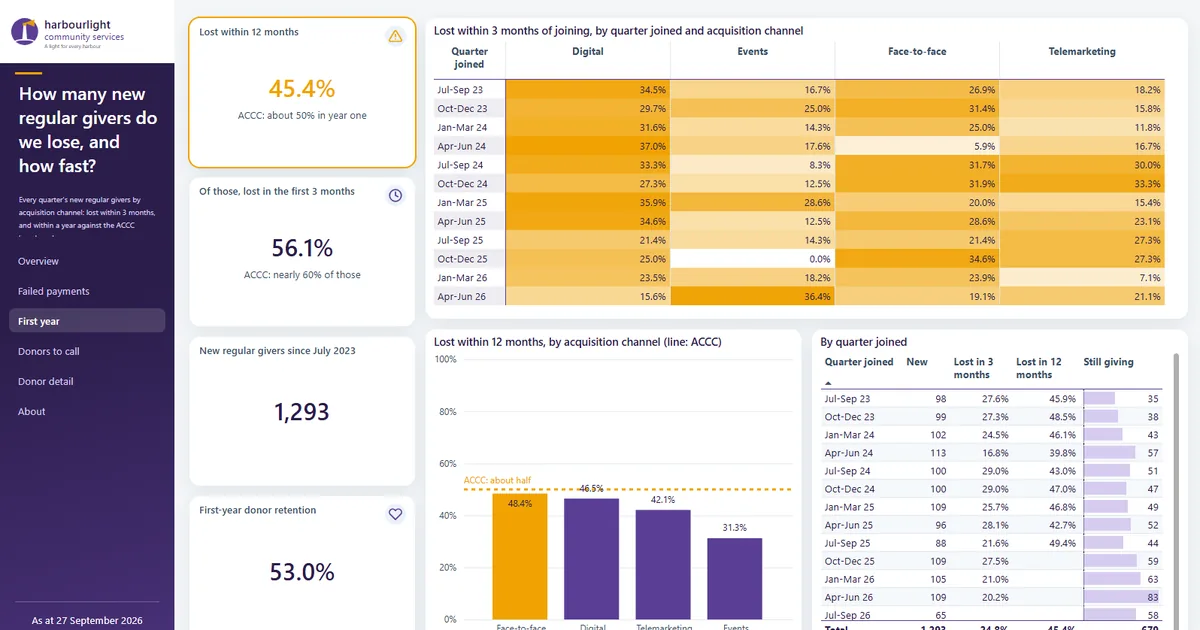
Lifetime value depends on keeping those donors. If half of a year’s new regular givers leave within 12 months, much of the lifetime value behind the acquisition budget leaves with them. That’s why the board should see acquisition cost next to first-year retention. Our post on donor retention rate shows how to measure it, and where the early loss comes from.
What should you report to the board?
- Cost per dollar by campaign type, against the rule of thumb. One line per method, with the benchmark range beside it.
- Full cost next to direct cost. Staff time included, so events and major gifts compare fairly with appeals.
- Acquisition on lifetime value and first-year retention. The first-year ratio on its own will always look like a loss.
- The trend over two years. A single large gift, or a campaign that straddles 30 June, can distort one year.
Getting there usually means joining the CRM, the general ledger and a simple record of staff time, and agreeing with finance which costs belong to which campaign. That’s the kind of data analytics consulting work behind the reports on our not-for-profit data analytics page.
Questions we’re asked
It depends on the method. As return per dollar spent, Greenfield’s 1989 guidelines give capital campaigns about 10 to 20 dollars and events about 2. The AFP’s figures give a second mailing about 5 and direct mail acquisition under 1 in its first year. About 5 overall matches Greenfield’s 20 cents. A lower return can be fine if it buys donors who give for years, and a very low cost can mean recruiting has stopped.
Divide what a campaign raised by what it cost. With illustrative figures, AUD 100,000 raised on AUD 25,000 of cost is a return of 4 dollars per dollar spent. The same figures give a cost of 25 cents per dollar raised. Net ROI subtracts the cost first and gives 3. Count costs the same way every time: invoices coded to the campaign in the general ledger, plus an honest estimate of staff hours.
There’s no standard, so pick a rule and keep it. One workable rule: count the first 12 months of gifts for the first-year ratio, and judge the acquisition decision on expected lifetime value. Show both, say which rule the report uses, and don’t change it mid-year, or you can’t compare campaigns from one year to the next.
Volunteer hours aren’t a cash cost, so leave them out of the ratio, but record them beside it. An event that runs on hundreds of volunteer hours depends on goodwill the ratio doesn’t show. If those volunteers move on, paid staff time replaces them and the cost per dollar rises. The time staff spend coordinating volunteers is a cost, and belongs in the full cost.
See what each campaign really costs
A fixed-price pilot, 4–6 weeks, scoped with you. Start with a free 30-minute meeting.