
Not-for-profit analytics
Not-for-profit analytics
Not-for-profit data analytics: show your impact, and keep the supporters who fund it
For charities whose board reads a finance pack and a separate impact report: Power BI reports that join your CRM, finance, grants and case data, so impact and sustainability sit in one view.
About 50%
of new regular donors are lost in their first 12 months, and nearly 60% of those go in the first three months. Source: ACCC research
42.9%
overall donor retention in 2024, the fifth year of decline in a row (US panel). Source: Fundraising Effectiveness Project
About 20 cents
to raise a dollar: the rule of thumb for annual fundraising. Source: AFP, quoting Greenfield
1 to 5
the scale on which DSS-funded services rate each client’s circumstances, goals and satisfaction, at the start and end of a service (SCORE). Source: DSS Data Exchange
Sector facts as at September 2026.
Report examples
Six not-for-profit data analytics reports on one fictional charity
Harbourlight Community Services is a fictional charity built on typical sector data: a large community services organisation in NSW and Queensland (homelessness, youth, family support and emergency relief), with revenue of about AUD 48 million, about 60% of it from government grants and contracts and 30% from donations. All six reports run on it, so the stories join up: a payment provider change that lapses regular givers and opens a gap between the CRM and the ledger, three acquittals due in November, and youth outcomes left in case notes.
Click a screen to see it full size.
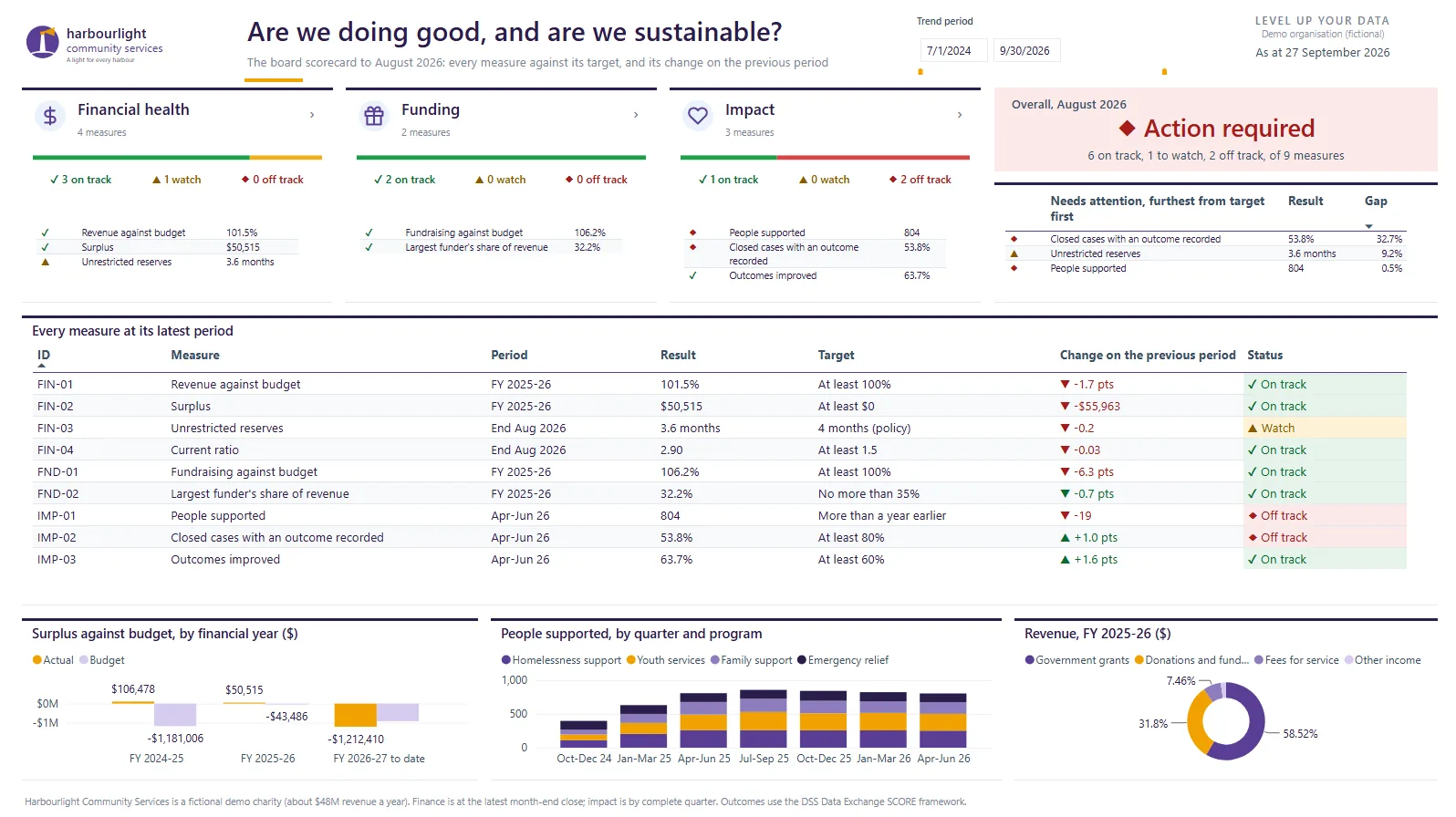
Board pack
CEO and board: Are we doing good, and are we sustainable? Nine measures across financial health, funding and impact, each against its target, with the gaps furthest from target listed first.
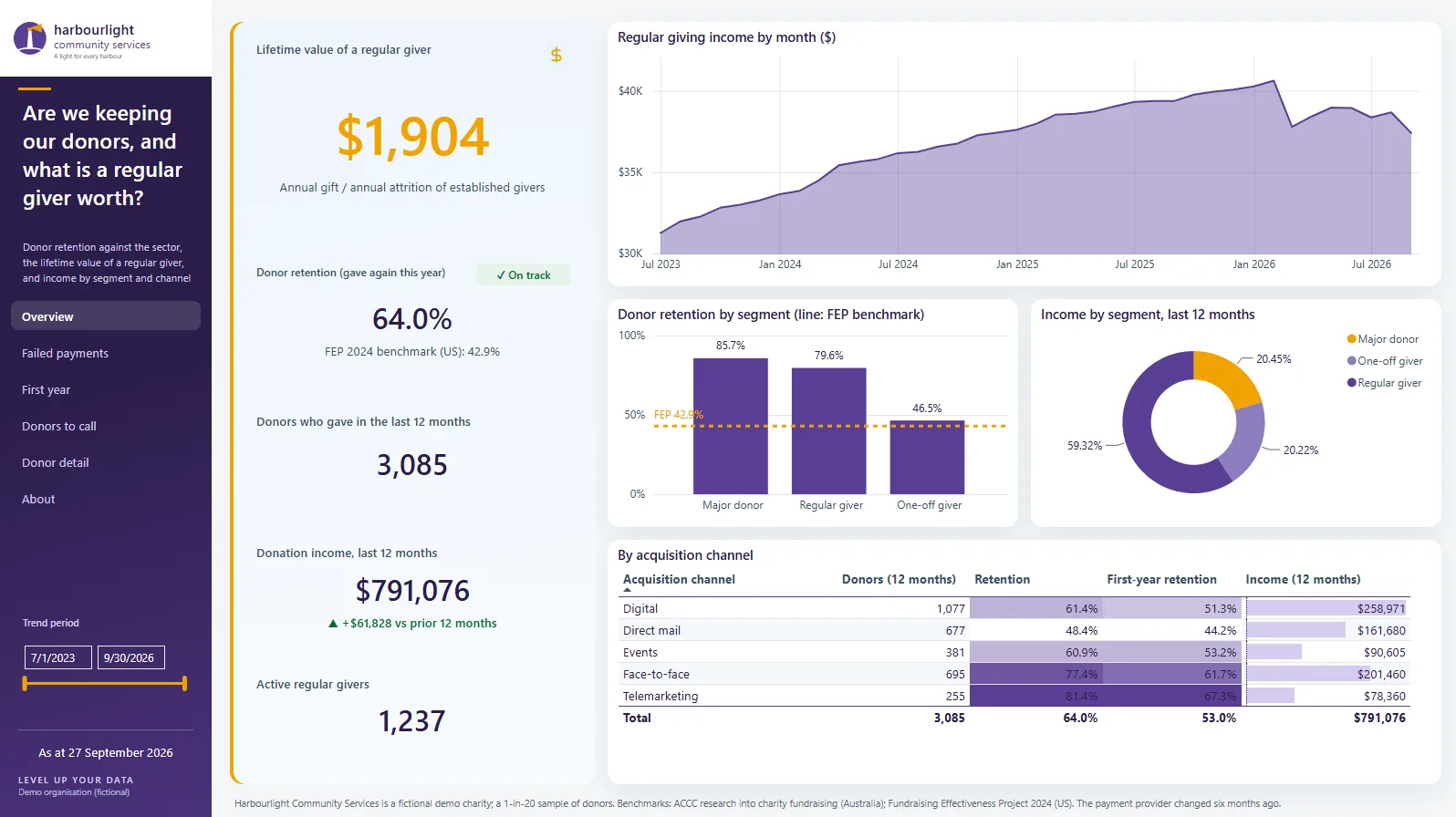
Donor retention
Head of Fundraising: Are we keeping our donors, and what is a regular giver worth? After the payment provider changed, failed debits tripled, from 3.1% to 9.5%. Regular givers who lapsed without choosing to become this week’s list of supporters to call.
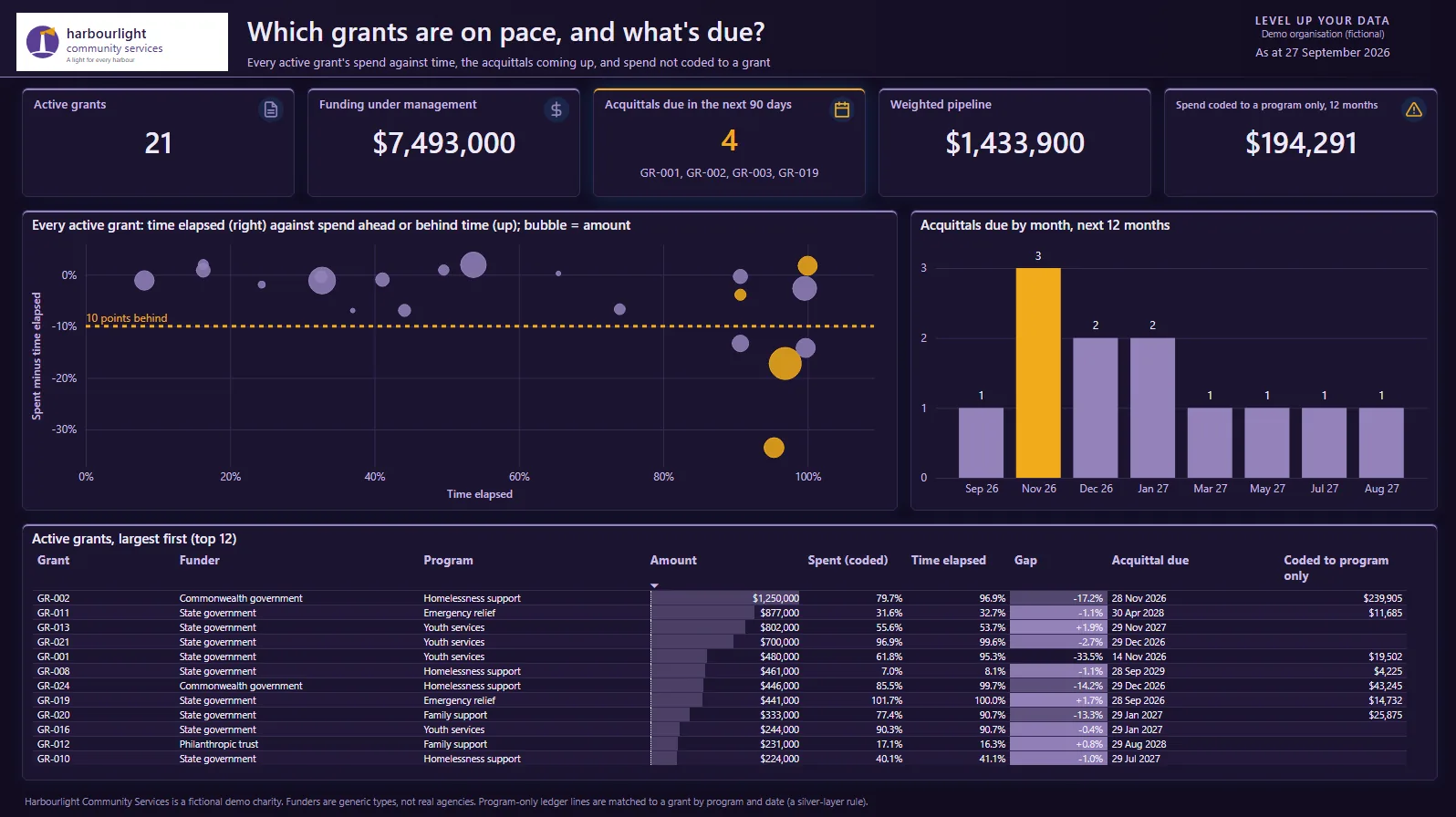
Grants and acquittals
CFO: Which grants are on pace, and what’s due? One grant looks 17 points behind only because about AUD 240,000 of its spend is coded to the program; another is heading for about AUD 148,000 unspent.
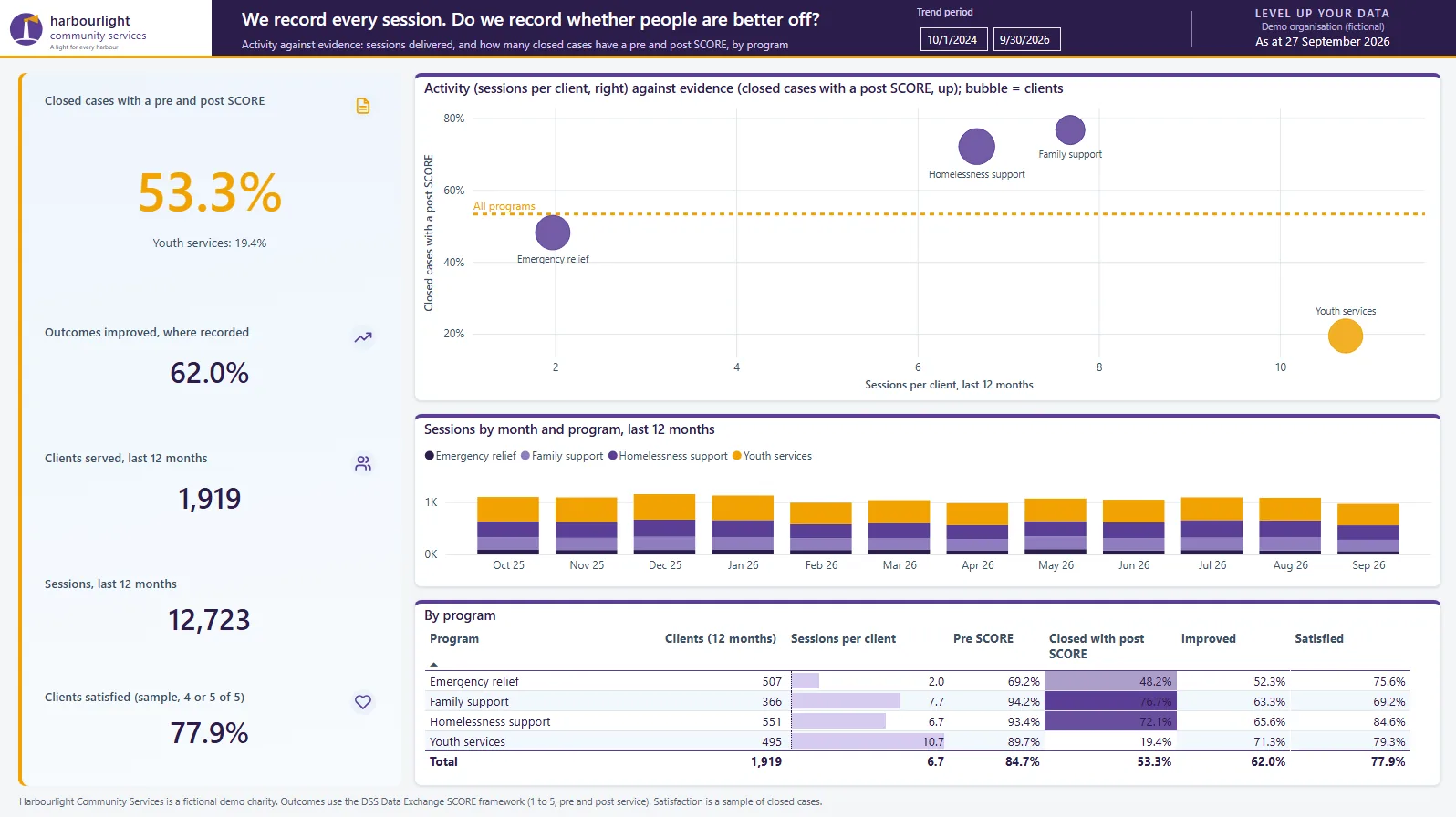
Program outcomes
Programs Director: Do we record whether people are better off? Where youth outcomes are recorded, 71% improved. 176 cases closed in the last 90 days need their outcome entered from the case notes.
Campaign return
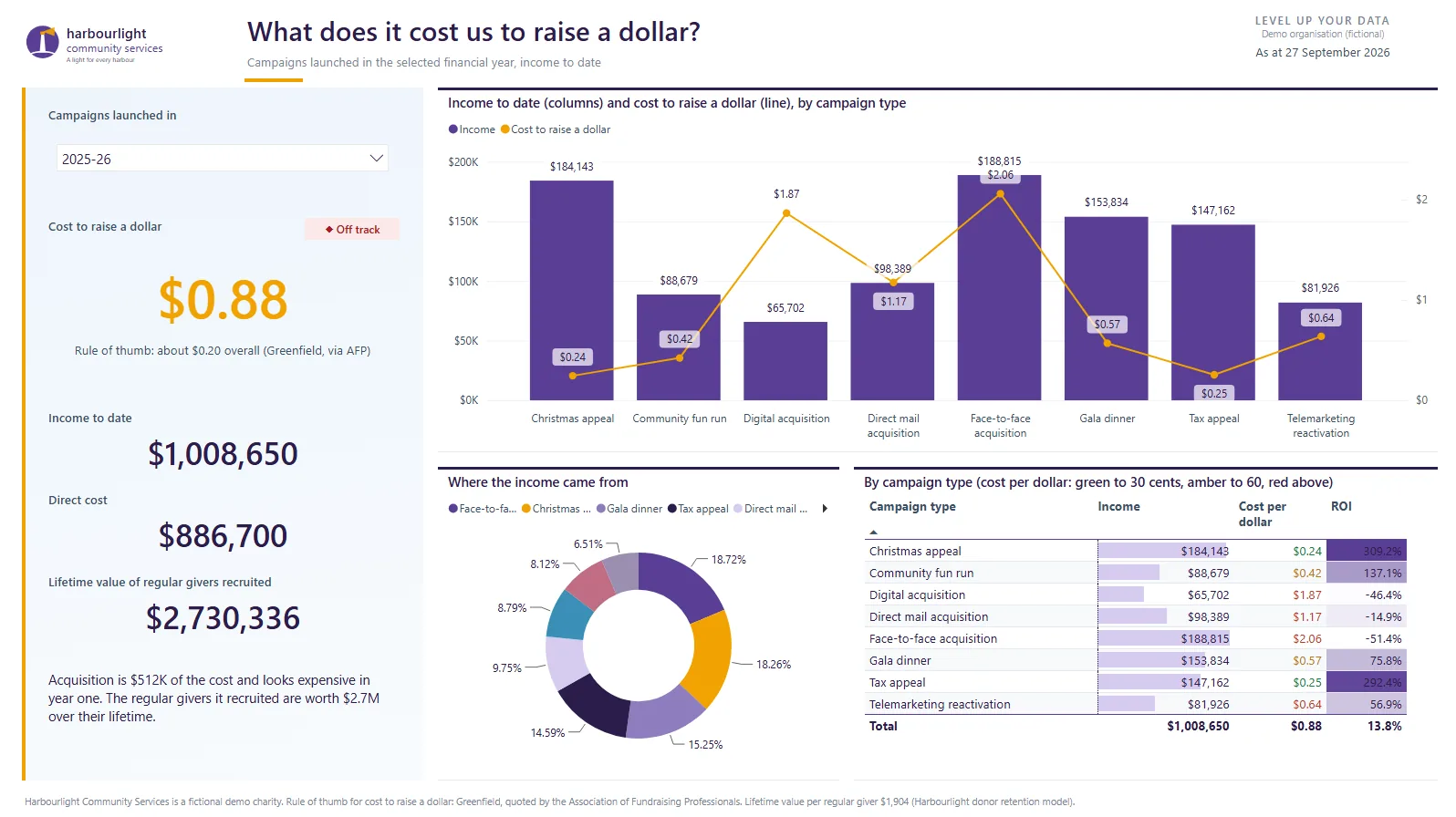
Head of Fundraising and CFO: What does it cost us to raise a dollar? Every campaign’s cost per dollar, direct and with staff time: the gala dinner’s AUD 0.56 becomes AUD 0.84 once staff time is counted.
CRM to finance
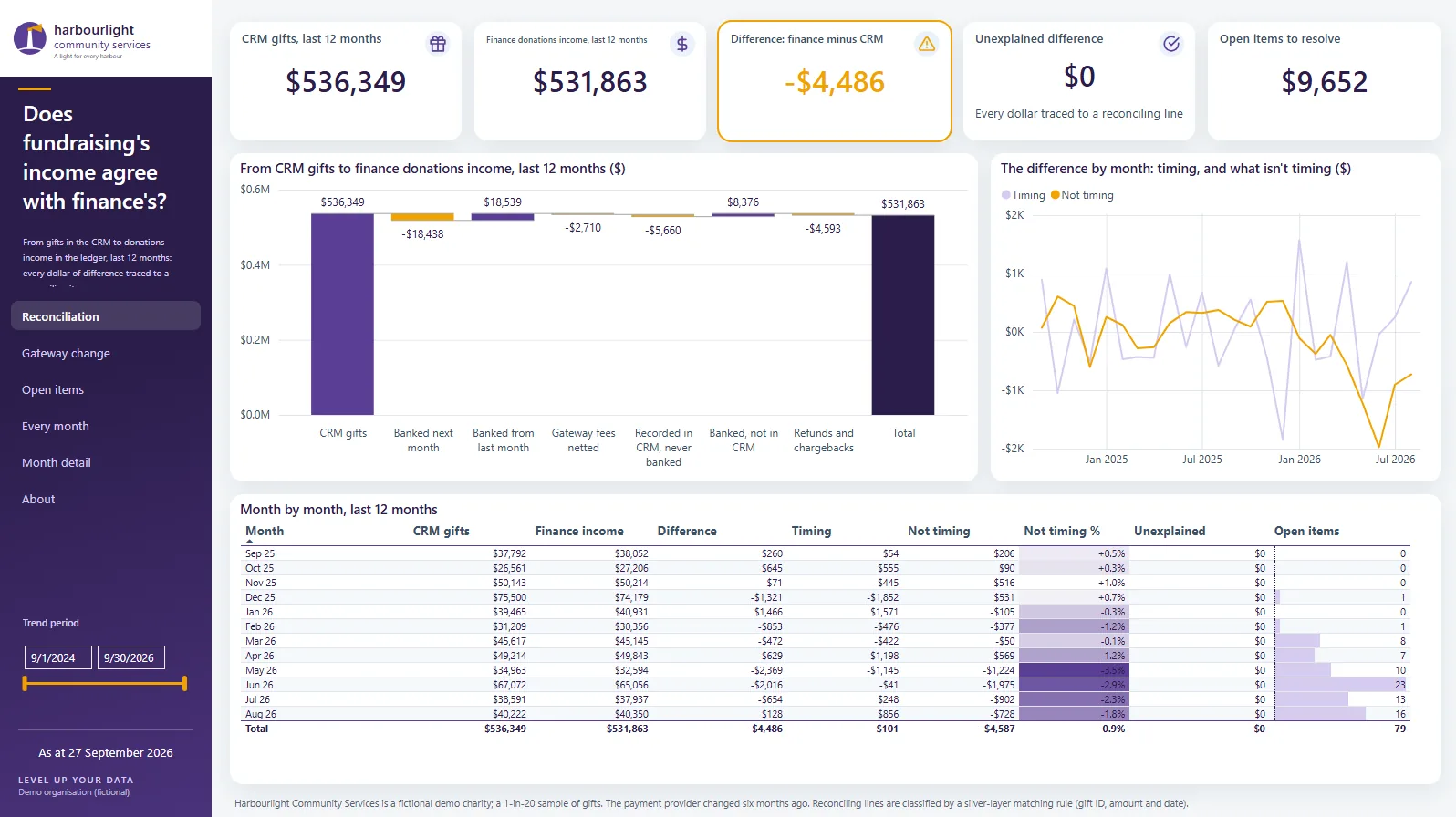
CFO: Does fundraising’s income agree with finance’s? Since the payment gateway changed, the part of the gap that isn’t timing has gone from +0.3% to −2.0% of gifts: netted fees, duplicate gifts that never bank, and refunds.
Sector pressures
Why isn’t a finance pack and an annual impact report enough any more?
Fundraising, finance, grants and programs each keep their own system, and the board sees them separately and late.
Regular giving
Most losses come early, and a failed debit nobody follows up looks just like a supporter who chose to leave (ACCC).
Fewer donors give again
Fewer donors give again each year, so what a supporter is worth over time matters more than any single appeal (Fundraising Effectiveness Project).
Outcomes, not activity
Funders want to know whether people are better off, not how many sessions ran; DSS-funded programs report outcomes through the Data Exchange (DSS).
Acquittals fall due together
Several acquittals can fall due at once, and spend coded to the program but not the grant looks like underspending, or money to hand back.
Annual reporting
Every registered charity lodges an Annual Information Statement with the ACNC; large charities, with AUD 3 million or more in revenue, add an audited financial report (ACNC charity size; ACNC 2025 AIS guide).
Governance
Data your board can trust
The reports connect to the systems you already run: your fundraising CRM, finance system, payment gateway, grants register and case management system. Grants register in a spreadsheet? We start from the spreadsheet. The model doesn’t change when the source improves.
- Every figure has an owner: the CFO for finance and acquittals, the Head of Fundraising for donors and gifts, the Programs Director for outcomes.
- Reconciled, not assumed: CRM gifts to the ledger every month, and grant spend to the signed funding agreement before each acquittal.
- Private by design: no donor or client names in the model, and no case notes.
Read more about our approach to data governance.
The pilot
How does a not-for-profit pilot work?
A fixed-price pilot, 4–6 weeks, scoped with you in a free 30-minute meeting: one question, answered on your own data and reconciled to your own figures.
Good starting points are donor retention, owned by your Head of Fundraising, or grants and acquittals, owned by your CFO. The report is tuned with whoever owns the question. See how we work for the week-by-week plan, and our tested delivery accelerators.
FAQ
Questions charities ask
A CRM reports on what it holds: donors, gifts and campaigns. Board questions cross systems: gifts against the ledger, grant spend against funding agreements, sessions against outcomes, campaign income against staff time. Power BI joins your CRM, finance, grants and case management data in one governed model, so fundraising, finance and programs work from the same figures, and nobody rebuilds the board pack by hand.
No. Harbourlight is fictional, built on typical sector data, and every figure in its reports is illustrative; funders appear as generic types, not real agencies. The benchmarks on this page come from the ACNC, the ACCC, the Department of Social Services and the AFP, linked and dated, and the retention benchmark is from a US panel. In a pilot, the same reports run on your own data.
The model holds donor and client IDs, not names, addresses or card details; those stay in your CRM and case management system. Row-level security shows a list of supporters to call only to supporter care, and a list of cases to update only to caseworkers and their managers. Funder reports suppress small numbers, so no one can be identified.
Yes. Ratings are checked against the 1 to 5 scale and the domains each program reports on, and counts are reconciled to your Data Exchange submission each reporting period. In week one we confirm with you which domains each program assesses, how your own assessment tools map to SCORE, and which start and end ratings count.
Usually for a handful of reasons: gifts banked the month after they’re recorded, gateway fees netted off before deposit, duplicate imports that never bank, and refunds that reach finance but not the CRM. The reconciliation report matches every gift and deposit by ID, amount and date, turns each difference into a reconciling line with an owner, and escalates items open longer than 60 days.
Related
See your impact and your funding in one view
A fixed-price pilot on your own data, 4–6 weeks. Start with a 30-minute meeting.