
In a council’s capital works program, most grant-funded projects come with a funding agreement: milestones, payments on evidence and a completion date. Councils usually spend before the grant arrives. A project that slips past its deadline can mean a variation request, a delayed payment or, in the worst case, funding withdrawn or repaid.
A capital works program is the set of capital projects a council plans to deliver, with their budgets. Portfolio reporting, such as the percentage of the capital budget spent, doesn’t show that risk. Tracking every grant-funded project’s forecast finish against its funding deadline does.
Key takeaways
- Of 29 NSW council projects over AUD 30 million each, only 7 were on time and on budget at 30 June 2025, and 14 were more than six months late (Audit Office of NSW, Local government 2025, 28 January 2026).
- NSW councils spent AUD 6.1 billion renewing and acquiring assets in 2024–25 (Audit Office of NSW, Local government 2025, 28 January 2026).
- Queensland councils spent AUD 5.8 billion on assets in 2024–25, and capital grants funded about 42% of it (Queensland Audit Office, Local government 2025, tabled 19 March 2026).
- The Audit Office of NSW’s Local government 2025 report (28 January 2026) lists, among its audit findings at councils, grant registers not regularly updated and reconciled, and grant funding not formally assessed against AASB 15 and AASB 1058, the standards that decide when grant revenue is recognised.
Updated October 2026
This post looks at what the NSW and Queensland auditors found, and why a healthy program total can hide a project in trouble. It then sets out the register fields and monthly routine that bring it to the surface early.
Why are grant-funded projects in a capital works program different?
A council’s own capital projects answer to its budget and its board. A grant-funded project also answers to a funder, under an agreement with its own dates and conditions.
Apart from the untied Financial Assistance Grant, most grants to councils come tied to a purpose and pay out as the council meets each milestone. The council pays the contractor first and claims the grant later, on evidence, so costs land before revenue. If a milestone or the completion date slips, the cash the council was counting on slips with it.
That makes the grant register as important as the project schedule. The Audit Office of NSW reported findings at councils of grant registers not regularly updated and reconciled, and of grant funding not formally assessed against AASB 15 and AASB 1058, the standards that decide when grant revenue is recognised (Audit Office of NSW, Local government 2025, 28 January 2026).
What did the auditors find?
Two state auditors, reporting in 2026 on the 2024–25 year, describe the same pattern: big programs, heavy reliance on grants, and large projects that run late.
NSW: most large projects late or over budget
Of 29 council projects over AUD 30 million each, with a combined budget of AUD 1.5 billion, only 7 were on time and on budget at 30 June 2025, and 14 were more than six months late. NSW councils spent AUD 6.1 billion renewing and acquiring assets in 2024–25 (Audit Office of NSW, Local government 2025, 28 January 2026).
Queensland: grants fund a large share of the program
Councils spent AUD 5.8 billion on assets in 2024–25, and capital grants funded about 42% of it (Queensland Audit Office, Local government 2025, tabled 19 March 2026).
Rural and remote councils carry the most risk
They have little own-source revenue and rely on state and federal funding to replace their assets (Queensland Audit Office, March 2026).
We haven’t found a published figure for grant funding lost to missed deadlines, and whether a late project loses funding depends on each agreement. What the findings do show is how often large projects run late, and how much of the money behind them comes with conditions attached.
Why does the program report hide it?
Spend against plan is a total. A grant deadline belongs to one project and one agreement. A program can look close enough to plan while a handful of grant-funded projects drift past their dates, because the total averages them in with everything else.
Ashford Vale Regional Council is a fictional council built on typical sector data. Its capital program is AUD 64.4 million planned this year and AUD 68.1 million forecast. It’s one of the report examples on our local government data analytics page.
Click a screen to see it full size.
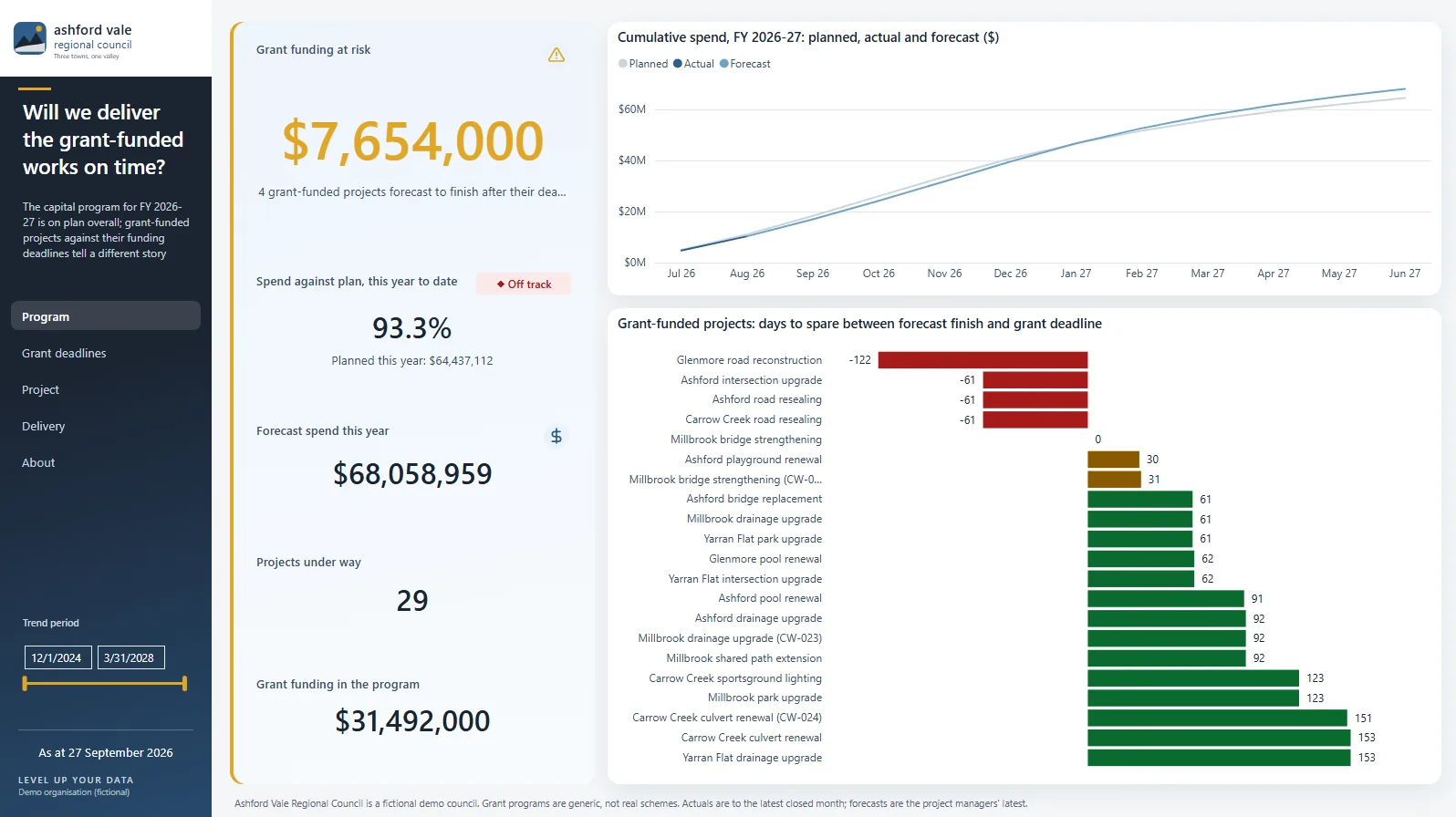
Ashford Vale Regional Council is fictional; grant programs are generic and figures illustrative.
The program view is what most executive reports show: spend to date, a forecast for the year, and AUD 31,492,000 of grant funding in the program. The bars on the right are what they usually leave out: days to spare between each project’s forecast finish and its grant deadline.
The second page puts the question directly.
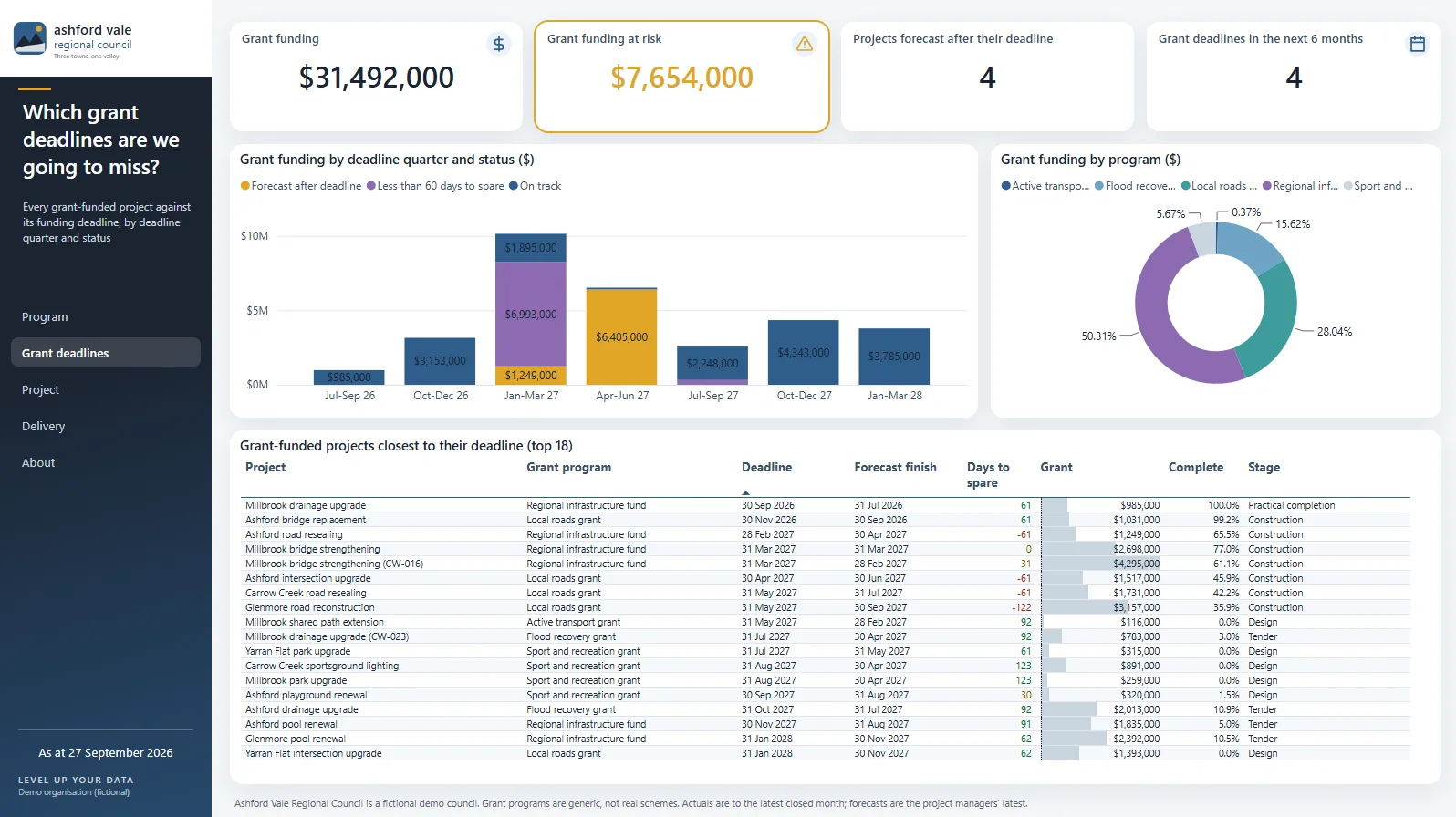
Four road projects are forecast to finish between 61 and 122 days after the dates in their funding agreements. None of them shows up as a problem in the program total. Each one is a conversation with a funder that’s better had now, with months to spare, than after the deadline has passed.
Take the worst of them. Glenmore road reconstruction has a grant deadline of 31 May 2027, is 35.9% complete, and its project manager now forecasts 30 September 2027. At the report date, 27 September 2026, that leaves about eight months to change something. Bring work forward, split the scope, or ask the funder for a new date with the reasons on paper. And the list doesn’t stop at the four. Millbrook bridge strengthening has no days to spare at all, so one more slip puts it on the same list.
What does a grant register need, from milestones to acquittal?
Most councils already keep a grant register. The question is whether it holds what’s needed to see a deadline coming, and whether anyone keeps it current. These are the fields we’d expect for every grant-funded project.
Fields every grant-funded project needs in the register
| Field | Why it matters |
|---|---|
| Grant program and agreement reference | Ties the project to its conditions |
| Grant amount and amount claimed to date | Shows what’s still to be earned |
| Milestones and their evidence dates | Payments depend on them |
| Completion deadline in the agreement | The date that matters, not the internal target |
| Forecast finish (project manager’s latest) | Updated monthly |
| Days to spare (deadline minus forecast finish) | Negative means at risk; flag anything under 60 days |
| Variation requested and approved | Evidence for the auditor and the funder |
| Ledger reconciliation date | Auditors look for it |
| Acquittal requirements and due date | The final report and evidence, often tied to the last payment |
A register is only as good as its owner. Someone has to own each field, and the register has to agree with the general ledger. That’s a data governance question as much as a reporting one: who owns the register, who updates the forecasts, and who signs off the reconciliation.
Which monthly routine protects grant funding?
Five steps, once a month, after the finance close:
- Refresh the forecasts. Ask each project manager for their latest forecast finish, not the date in the original plan.
- Recalculate days to spare. Deadline minus forecast finish, for every grant-funded project, sorted with the least time first.
- Ask for variations early. Anything under 60 days, or already negative, goes to the funder before the deadline passes, not after.
- Reconcile the register to the ledger. Grant revenue claimed and received should match finance, project by project.
- Report grant funding at risk. One number and a short list to the executive and the audit committee, every month.
The data for this usually sits in three places: the finance system, the project or capital works tracking tool, and the grant register itself, often a spreadsheet. Joining them once, and refreshing them each month, turns the routine from a week of chasing into a report that’s ready when the close is done.
Questions we’re asked
It’s a council’s list of the capital projects it plans to deliver, such as new or renewed roads, bridges, drainage, buildings and parks, with a budget for each. Most councils adopt it with the annual budget, covering the coming year and often the next few, and report progress against it during the year. Projects paid for with grants also carry the conditions of their funding agreements.
It depends on the funding agreement. Most set out how to ask for a variation. A request made before the deadline, with the reason and a realistic new date, gives the funder time to consider it. A missed date can hold up the next payment, and in the worst case the funder can withdraw funding or ask for money back. Read each agreement’s variation clause early.
It’s the report, with evidence, that shows a funder the grant was spent as the agreement required: what the council delivered, what it cost and when. Many agreements tie the final payment to an accepted acquittal, and the exact requirements depend on each agreement. Keeping invoices, milestone evidence and the ledger reconciliation current during the project makes the acquittal much quicker at the end.
Track them one by one against the deadline in each funding agreement rather than against the internal schedule. Keep the forecast finish current every month, and reconcile grant claims to the general ledger. Report grant funding at risk as its own measure, so the executive sees it next to spend against plan rather than buried inside it.
See every grant deadline in one view
A fixed-price pilot, 4–6 weeks, scoped with you. Start with a free 30-minute meeting.