
Care minutes are the minutes of direct care each resident receives per day from registered nurses, enrolled nurses and personal care workers. They count against each home’s own targets for total and registered nurse (RN) minutes. Since 1 April 2026 they also set part of a metropolitan (MM1) home’s funding, through the care minutes supplement (Department of Health, Disability and Ageing fact sheet, April 2026).
Key takeaways
- Since 1 April 2026, metropolitan (MM1) residential aged care homes without specialised homeless status receive up to AUD 34.26 per resident per day of their care funding as a care minutes supplement, at the AN-ACC price from 1 October 2026 (Department of Health, Disability and Ageing, care minutes funding fact sheet, April 2026).
- The supplement is nil for a home that delivers under 85% of both its total and its RN targets (Department of Health, Disability and Ageing, care minutes funding fact sheet, April 2026), and performance is truncated to two decimal places, not rounded (Department of Health, Disability and Ageing, care minutes supplement FAQs, October 2026).
- Performance in one quarter sets the supplement for the quarter that starts six months later, so October to December 2026 sets April to June 2027 (Department of Health, Disability and Ageing, care minutes funding fact sheet, April 2026).
- The 215 total and 44 RN care minutes per resident per day are a sector-wide average; each home has its own targets, based on its residents’ care needs (Aged Care Quality and Safety Commission, 24/7 registered nurse and care minutes obligations, checked October 2026).
- In April to June 2026, 66.32% of the 2,536 homes that reported met both their total and RN targets (Department of Health, Disability and Ageing, care minutes dashboard, April to June 2026).
Updated October 2026
The base care tariff fell from 0.5 to 0.387 NWAU. The difference is worth up to AUD 34.26 per resident per day at the AN-ACC price of AUD 303.19 from 1 October 2026. It comes back on a sliding scale that follows how much of its own total and RN targets each home delivered in the quarter that began six months earlier. Below 85% of both targets, the supplement is nil. Because the payment is per home, a group average that meets 215 and 44 minutes can hide homes that receive less.
This post sets out how the supplement works, what the sliding scale pays and why each home’s targets differ. It ends with what to watch every week so the quarter holds no surprises.
How does the care minutes supplement work?
The rules, from the Department’s April 2026 fact sheet and its frequently asked questions (October 2026):
- Who it applies to: homes in Modified Monash 1 (metropolitan) areas without specialised homeless status. Regional, rural and remote homes are not affected.
- What moved: 0.113 NWAU of the base care tariff, worth AUD 34.26 per resident per day from 1 October 2026. The base care tariff that remains is AUD 117.33.
- No application: Services Australia pays it automatically each month.
- A six-month lag: performance in one quarter sets the rate for the quarter that starts six months later. Minutes delivered from October to December 2026 set the supplement for April to June 2027.
- Enrolled nurses count, up to a point: EN care time can make up to 10% of a home’s RN target.
- Truncated, not rounded: the Department shortens performance to two decimal places, so 94.999% is 94.99%, and sits in the band below 95%.
The lag changes what finance can influence. By the time a supplement arrives, the quarter that set it closed months ago. The only quarter still open is the current one: October to December 2026 sets the rate for April to June 2027, the last quarter of this financial year.
What does the sliding scale pay?
Two slices of the Department’s Table 1, in AUD per resident per day from 1 October 2026. The full table has eight RN bands.
| Total care minutes delivered | RN minutes at 100% or more | RN minutes below 85% |
|---|---|---|
| 100% or more | 34.26 | 31.23 |
| 97.5% to under 100% | 32.14 | 29.11 |
| 95% to under 97.5% | 31.53 | 28.50 |
| 92.5% to under 95% | 25.77 | 22.74 |
| 90% to under 92.5% | 20.31 | 16.98 |
| 87.5% to under 90% | 14.55 | 11.22 |
| 85% to under 87.5% | 8.79 | 5.76 |
| Under 85% | 3.03 | 0 |
Read down the columns: total care minutes move the payment far more than RN minutes. A home that meets its RN target but delivers 90% of its total target receives AUD 20.31, about AUD 14 less than the maximum. A home that meets its total target but delivers under 85% of its RN target receives AUD 31.23, about AUD 3 less.
The steps aren’t even, either. With the RN target met, each band below 95% of the total target is worth up to AUD 5.76. Above 95%, the steps shrink to AUD 2.12 or less. The 95% line is where most of the money sits.
The Department’s worked example shows how fine the margins are. A home with targets of 220 total and 45 RN minutes delivers 218 and 43 over October to December 2026: 99.09% and 95.55% of its targets. Instead of AUD 34.26, it receives AUD 31.53 for April to June 2027. For a home with 100 residents, that AUD 2.73 a day is about AUD 24,800 over a 91-day quarter (our arithmetic, for illustration).
RN shortfalls still cost you, just not mainly through this supplement. The 24/7 registered nurse requirement is a separate obligation, and Staffing, measured by care minutes against targets, makes up 22% of a home’s Star Rating.
Why does each home have its own care minutes targets?
The figures everyone quotes, 215 total care minutes and 44 RN minutes per resident per day, are sector averages (Aged Care Quality and Safety Commission). Each home’s own targets are based on its residents’ care needs, which is why the Department’s example home has 220 and 45. A home with frailer residents needs more than 215 to earn the full supplement, and a group can average 215 while one of its homes falls short.
Many homes do. In April to June 2026, 2,536 homes reported care minutes: 71.61% met their total target, 83.79% their RN target, and 66.32% both (Department of Health, Disability and Ageing, care minutes dashboard, April to June 2026). A third of homes missed at least one target in the supplement’s first quarter.
What does a group average hide?
The screens below come from one of our aged care analytics reports, built on Wattlecrest Care Group, a fictional provider with six homes. They answer the question a quarterly return can’t: whether the average hides weekend shortfalls.
Click a screen to see it full size.
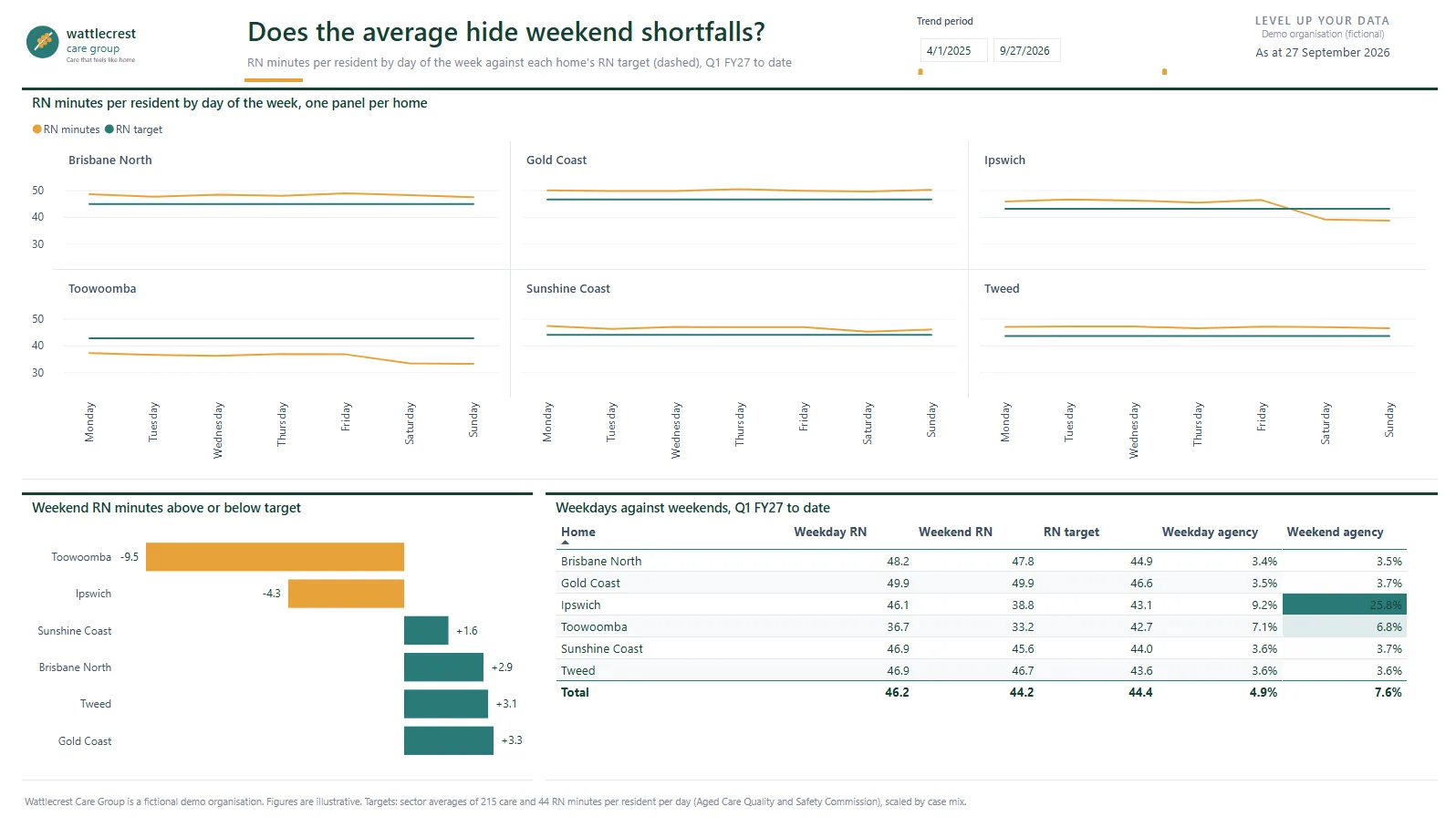
Wattlecrest Care Group is fictional, built on typical sector data; figures are illustrative.
For July to September 2026, the quarter the report shows, the group’s weekend RN minutes sit just under target: 44.2 against 44.4. Inside that average, Ipswich, with a target of 43.1, delivers 46.1 RN minutes on weekdays and 38.8 at weekends. A quarter of its weekend hours come from agency staff. Yet Ipswich still meets its quarterly RN target. That’s exactly why a quarterly view doesn’t warn you: five strong days cover two short ones, and residents on Saturday and Sunday still get less nursing time.
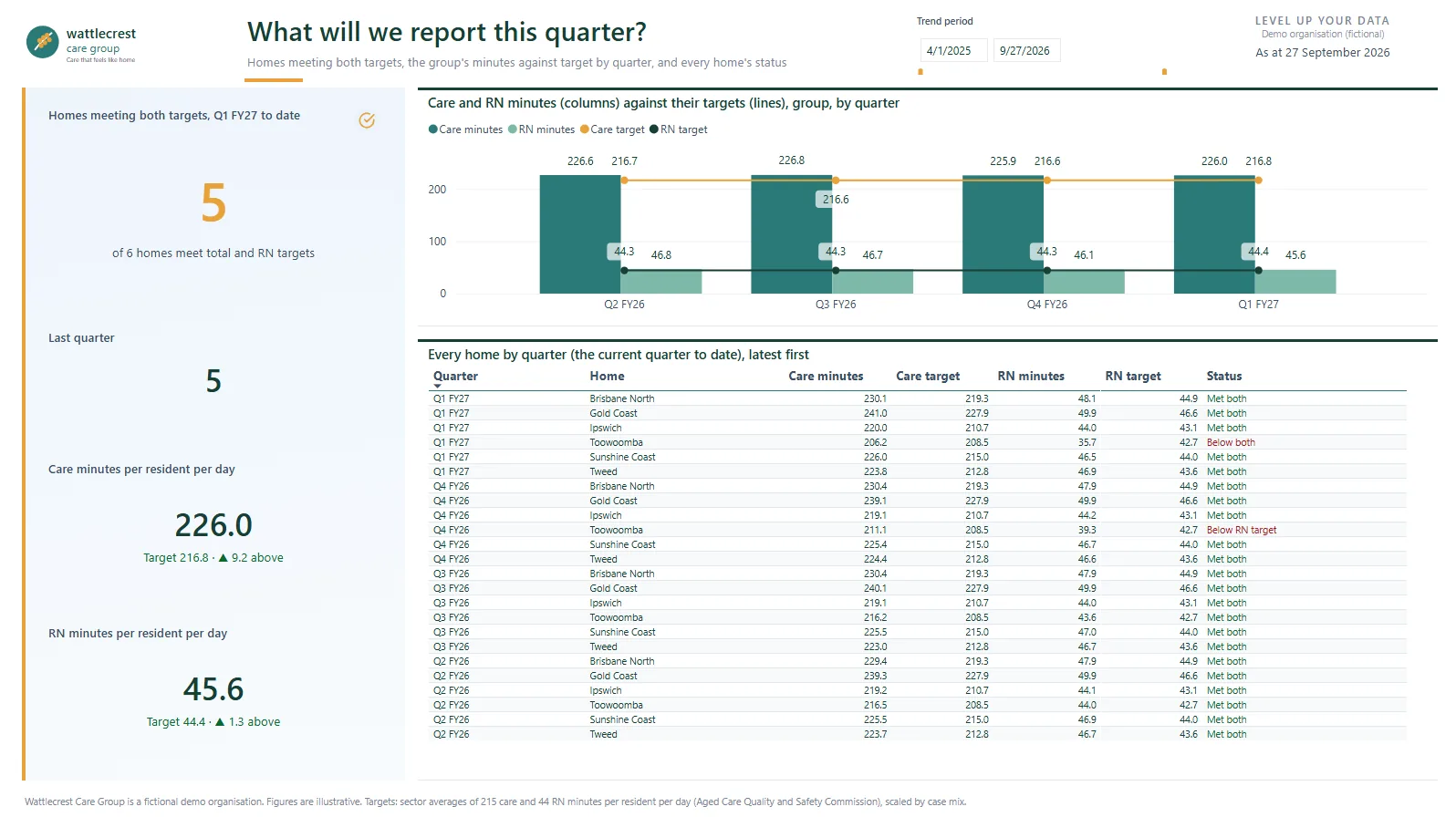
The quarterly page tells the story the Department will see. Five of six homes meet both targets. Against targets of 216.8 and 44.4, the group delivers 226.0 minutes and 45.6 RN minutes. Toowoomba is below both: 206.2 against 208.5, and 35.7 RN minutes against 42.7. It’s short every day of the week and furthest behind at weekends. As with aged care occupancy rates, the group figure says little about the home that needs attention.
What should you watch every week?
A quarter is 13 weeks, and its last day fixes the band you land in. Track these weekly for each home:
- Total and RN minutes against the home’s own targets, week to date and quarter to date, not against 215 and 44.
- Weekends and nights on their own. Averages across the week hide the shifts that are hardest to fill.
- Agency share by home and shift. A rising share is often the first sign of a roster that can’t hold.
- The projected quarter result against the bands. If a home is heading for 94.9% of its total target, a few extra shifts now can lift it into the 95% band.
- The quality of the hours you’ll report. Only direct care counts; meals, laundry and cleaning don’t. From the 2025–26 Aged Care Financial Report, providers prepare a Care Minutes Performance Statement and have it externally audited. That makes data quality in rostering and payroll a funding question, not just a reporting one.
For a home like Ipswich, the answer is a weekend RN roster that relies less on agency staff, not more hours across the week. Most of the data for these checks already sits in your rostering, payroll and care management systems. The work is joining it, applying the Department’s counting rules, and checking the totals against your Quarterly Financial Report before you submit it.
Questions we’re asked
They’re the time nursing and care staff spend directly with residents, averaged per resident per day across a quarter: registered and enrolled nurses, plus personal care workers. Cleaning, laundry and meals don’t count. Every home reports them against two targets of its own, a total and an RN target, and the results flow into its Star Rating and, in metropolitan areas, its funding.
Divide the minutes a home actually delivered by its target, multiply by 100, then cut the result to two decimal places. The Department’s own example: 215.45 delivered against a target of 218.58 gives 98.568%, recorded as 98.56%. The same steps apply to RN minutes. Results above 100% can appear in the provider portal and earn the maximum rate.
A monthly payment that returns part of a metropolitan home’s base care funding, cut back in April 2026. Homes that deliver all their care minutes get it all back; homes that fall short get less, on a sliding scale. It arrives with each monthly claim as a separate line in the payment summary, and its rate comes from how the home performed two quarters before.
No, and they don’t need it. Homes outside Modified Monash 1 areas, and metropolitan homes with specialised homeless status, keep their base care tariff in full under AN-ACC, so none of their care funding depends on the supplement. Their care minutes and registered nurse obligations still apply, and still count towards Star Ratings.
Each home has two, one for total care minutes and one for RN minutes, both expressed per resident per day and adjusted for how frail its residents are. The well-known 215 and 44 are only the sector’s averages. A home with frailer residents carries higher targets, so check every home against its own pair rather than the averages.
See every home’s care minutes, every week
A fixed-price pilot, 4–6 weeks, scoped with you. Start with a free 30-minute meeting.