

The Support at Home program is the Australian Government’s scheme for older people who need care to keep living at home. It replaced Home Care Packages on 1 November 2025. You can see families relearning the system in what they type into Google. Australians searched for “support at home program” 45,600 times in the 12 months to September 2026. The year before it was 21,080, so that has more than doubled. “home care package” went the other way, down 47% over the same year.
We pulled two years of Google’s figures for 30 aged care searches, Australia-wide and for six local areas. Then we put them next to a provider’s enquiries in Power BI. Why bother? Because a family tells Google what it’s trying to work out long before it rings anyone, and the figures cost nothing.
Key takeaways
- Australians searched for “support at home program” 45,600 times in the 12 months to September 2026, up 116% from 21,080 the year before (Google Ads search volumes via DataForSEO, October 2026).
- Searches in Australia for “home care package” fell 47%, from 110,000 to 58,300, in the year to September 2026, after peaking at 14,800 in September 2025 (Google Ads search volumes via DataForSEO, October 2026).
- Searches in Australia for My Aged Care’s phone number and login rose 54%, from 140,000 to 215,100, in the year to September 2026 (Google Ads search volumes via DataForSEO, October 2026).
- Australian searches for residential care, home care, respite and dementia care fell 26% in the year to September 2026 (Google Ads search volumes via DataForSEO, October 2026).
Updated October 2026
What is the Support at Home program?
Support at Home started on 1 November 2025, replacing the Home Care Packages Program and Short-Term Restorative Care (Department of Health, Disability and Ageing, Support at Home program). Each participant gets a quarterly budget, and the size of it depends on their classification. There’s a fair bit to that, including what happens to money left unspent at the end of a quarter. We’ve put it in its own post: Support at Home budgets: unspent funds, rollover and what providers should watch.
A rename on that scale takes a while to reach the kitchen table. A daughter who has been saying “home care package” since her mother’s first assessment doesn’t start saying “Support at Home” on 1 November because the legislation did. She hears the new name from a provider or a letter. She finds the budget and the contribution have changed too. Then she goes to Google with whatever words she has, old ones included.
How did searches change when Support at Home began?
The table compares the 12 months to September 2026 with the 12 months before, using Google’s own monthly volumes for Australia. We tracked 30 searches; these eight carry most of the story.
Searches a year, Australia
| Search | Oct 2024 to Sep 2025 | Oct 2025 to Sep 2026 | Change |
|---|---|---|---|
| support at home program | 21,080 | 45,600 | +116% |
| support at home | 42,500 | 53,900 | +27% |
| home care package | 110,000 | 58,300 | −47% |
| home care | 80,100 | 48,400 | −40% |
| my aged care phone number | 64,400 | 102,100 | +59% |
| my aged care login | 75,600 | 113,000 | +49% |
| aged care assessment | 29,300 | 30,300 | +3% |
| acat assessment | 66,200 | 54,200 | −18% |
Google Ads search volumes for Australia via DataForSEO, pulled 22 October 2026. Google rounds its monthly volumes and lumps close variants together, plurals for instance, so treat each figure as a size rather than a count.
The monthly figures are where you see the handover. “home care package” had its busiest month of the two years in September 2025: 14,800 searches, the month before the change. Then it dropped to between 3,600 and 5,400 a month, and stayed there every month of 2026. The program’s own name did the reverse: 5,400 searches in October 2025 and 5,400 again in November. From June 2026 it drifted down to 2,900 a month. “my aged care phone number” took no notice and just kept growing, 5,400 searches in October 2024, 12,100 by September 2026.
Read those rows together and the shift is from “what kind of care” to “how does this work and who do I ring”. Before anyone panics about a falling number, though: Google now answers more questions on the results page itself, without a click. So a drop in searches isn’t only a drop in demand. Which is why we compare one search with another, and don’t read much into one month against the next.
What are families trying to work out?
What the new program is
Add the two Support at Home searches together and you get 99,500 a year, up 56%. The old name hasn’t gone anywhere, though: “home care package” still had 58,300 searches of its own.
How to get assessed
About 30,000 searches a year for “aged care assessment”, same as before. “acat assessment”, the older name, fell 18%.
Who to call
215,100 searches a year for My Aged Care’s phone number and login, between them. That is a lot of looking for the front door, before a provider comes into it.
What does it look like for one provider?
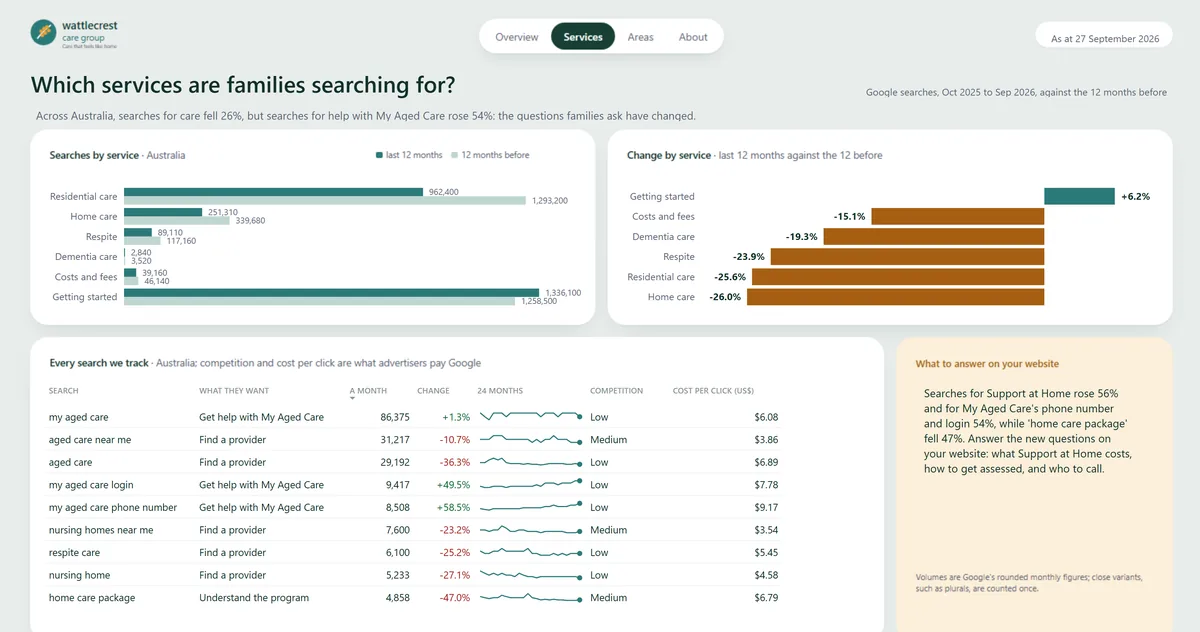
Wattlecrest Care Group is a fictional provider with six homes across South East Queensland and Northern NSW, and one of the report examples on our aged care analytics page. The searches in its report are the real Google volumes for Brisbane, the Gold Coast, Ipswich, Toowoomba, the Sunshine Coast and Tweed Heads. The enquiries we made up.
Searches for care across those six areas dropped from 222,110 a year to 181,960. Wattlecrest’s enquiries didn’t move: about 119 a month, as they had been all along. On its own that number is reassuring, and that’s the trouble with it. Next to the searches it means something else entirely. Wattlecrest is getting a bigger slice of a smaller pie. And the families who do ring are probably asking different questions from the ones who rang two years ago.
Click a screen to see it full size.
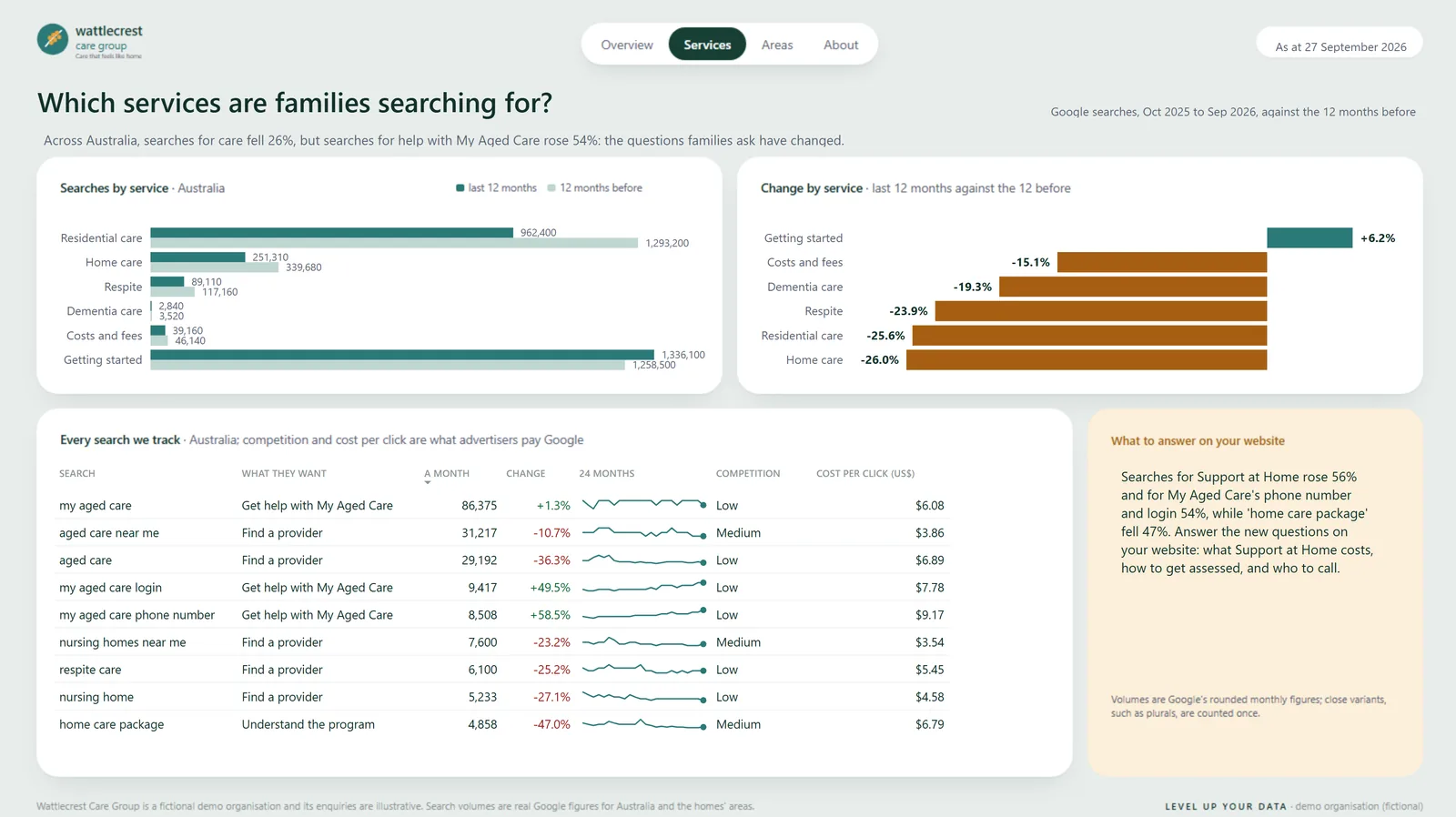
Wattlecrest Care Group is fictional and its enquiries are illustrative; the search volumes are real Google figures.
The report’s services page also shows what advertisers pay Google for a click on each search. The program’s name goes for about 4 US dollars a click. “my aged care phone number” costs more than twice that, about 9 US dollars, and somebody is paying it.
What should providers answer on their website?
Answer the questions families are actually typing, in their words, on the page they land on, not three clicks in. Four things cover most of it.
- Use both names. Support at Home in the headings, and one early sentence saying it replaced Home Care Packages. 58,300 searches a year still use the old name. A family that typed it needs to know within a second that this is the right page.
- Explain the cost plainly. What a participant pays under Support at Home, with one worked example, on its own page. That is the question hiding behind “aged care fees” and “aged care costs”.
- Show the way in. How to get assessed, the My Aged Care number (1800 200 422), and what happens after a family rings you. Someone searching for that phone number is one step from choosing a provider, and it might as well be you.
- Measure it monthly. Searches for your homes’ areas, next to your enquiries, every month. If the searches go up and your enquiries don’t, families are finding someone else, and you’ll know which month it started.
We go through how to measure your share of local demand, home by home, in Aged care marketing: are families finding you, or another provider?
Questions we’re asked
Monthly. Google publishes a month’s volumes during the following month, so a monthly pull lines up with your enquiry reporting. There is nothing new to see in between, because the figures only change once a month. That is still quick enough to catch a program change, a competitor’s campaign or a seasonal peak a few weeks after it starts.
Because families search for the words they know. While the new name is still unfamiliar, some of the searches keep going to the old term. Some go to the government’s own site. Some get answered on Google’s results page without anyone clicking anything. Look at the old and new names together and watch the mix move.
Yes. Google Ads has a location for each of your homes’ areas. The monthly searches for the terms you care about can be pulled for each one and joined to your own enquiries in Power BI. Our aged care pilot sets that up in four to six weeks.
See what families search for in your areas
A fixed-price pilot, 4–6 weeks, scoped with you. Start with a free 30-minute meeting.