
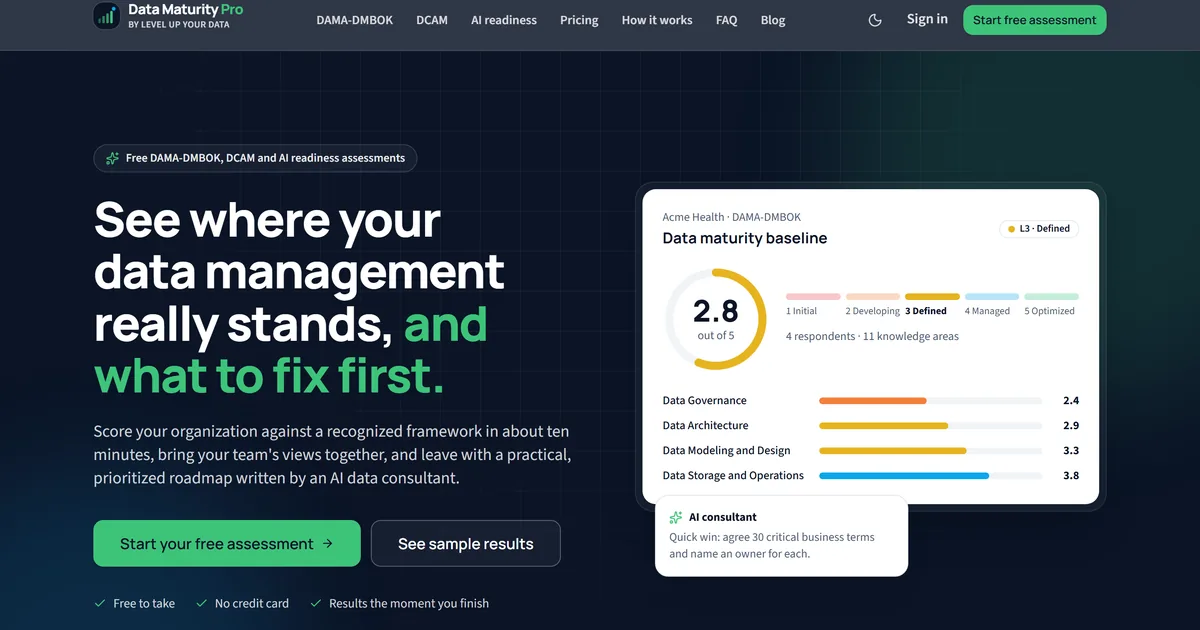
Data Maturity Pro is our new online tool for scoring how well your organisation manages data. Since November 2026 it also scores how ready you are to use AI. You pick a framework (DAMA-DMBOK, a DCAM-aligned model or the AI Readiness and Maturity Assessment) and answer questions written in plain English. An overall level and a score for every area appear the moment you finish, free. You pay once, for one assessment, only when you want your team’s combined view and a report for leadership.
Key takeaways
- Data Maturity Pro’s pricing page (November 2026) lists a free assessment, a Full report at a one-off USD 99 per assessment and an Expert review at USD 399, with no subscription.
- The Quick assessment has two questions per area and takes about 10 minutes (Data Maturity Pro FAQ, November 2026).
- The Detailed assessment takes about 45 minutes: 66 questions for DAMA-DMBOK and 56 for the DCAM-aligned and AI readiness assessments (Data Maturity Pro FAQ, November 2026).
- The AI readiness assessment scores eight areas from 1 (Initial) to 5 (Optimised), with questions mapped to the public structure of the EU AI Act, ISO/IEC 42001 and the NIST AI Risk Management Framework; its page says the results are not legal advice or a certification (November 2026).
- Industry benchmarks are opt-in and shown only in aggregate, across at least 5 organisations (Data Maturity Pro FAQ, November 2026).
Updated November 2026
Why did we build Data Maturity Pro?
We already run data maturity assessments as consultants. We interview the people who run each area, read the documents they point us to, score 13 areas and write a plan. That takes time from your people and ours, and you may want an answer before deciding whether a full engagement is worth it.
A body of knowledge such as DAMA-DMBOK describes good data management in detail. What it can’t do is place your organisation on its scale, or pick the two or three areas worth working on next. Data Maturity Pro does that first pass online. A head of data can get a baseline over a coffee, then bring in colleagues when the question becomes “do we agree on this?”
It is a self-assessment, and that has limits. People score their own area as they see it, and plans sometimes get counted as practice. Our data governance assessment questionnaire is a good warm-up for the same reason. In the tool, each question describes five concrete states, so you choose the one that matches what happens today. A “Don’t know” answer is left out of the score instead of being guessed.
What does each assessment measure?
All three use the same five levels: Initial, Developing, Defined, Managed and Optimised. The questions are the product’s own, mapped to the public structure of each framework.
DAMA-DMBOK: eleven knowledge areas
The DAMA-DMBOK maturity assessment follows the DAMA Wheel, with data governance at the centre. Around it sit ten more areas:
- architecture
- modelling and design
- storage and operations
- security
- integration and interoperability
- documents and content
- reference and master data
- warehousing and business intelligence
- metadata
- data quality
If the wheel is new to you, our post on data governance in the DMBOK explains why governance sits in the middle.
DCAM-aligned: eight capability components
This one treats data management as a program you fund and run. Where DAMA asks about knowledge areas, the DCAM-aligned questions ask whether a strategy exists and whether money and people sit behind it. Then they ask whether it gets delivered and whether it is controlled. The components start with Data Management Strategy and Business Case, and Program and Funding. Two architecture components and Data Quality Management follow, then Data Governance, the Data Control Environment and Analytics Management.
AI readiness: eight areas, added in November 2026
The newest of the three, the AI readiness assessment, looks past the tools at whether AI can be used well and safely. Its eight areas start with strategy and value and the operating model behind it. They move through use cases and delivery, data readiness and platforms, and finish with governance and compliance, responsible AI and trust, and skills, culture and adoption.
One of its Quick questions shows the style: “Do you have an AI policy that people know and follow?” The lowest answer is “There is no AI policy.” In the middle answer, a policy has been approved and published, staff have been told about it, and new uses of AI are checked against it.
Level Up Your Data isn’t affiliated with or endorsed by NIST, ISO or the European Union, nor by DAMA International or the EDM Council.
Which assessment should you choose?
| Assessment | What it scores | Choose it when |
|---|---|---|
| DAMA-DMBOK | 11 knowledge areas, governance at the centre (22 Quick / 66 Detailed questions) | You want a broad view of data management, or a baseline before a governance program starts |
| DCAM-aligned | 8 capability components (16 Quick / 56 Detailed questions) | You run or plan a funded data management program and must show how it is funded and controlled, for example in a regulated financial services team |
| AI readiness | 8 areas, from strategy to adoption (16 Quick / 56 Detailed questions) | You are deciding where to invest in AI next, moving pilots into everyday use, or getting ready for an AI standard or new AI rules |
Question counts from each framework page on datamaturitypro.com, November 2026. Both modes are free for all three.
If you can’t decide, the product’s FAQ suggests DAMA-DMBOK as the broad option that suits most organisations. Two assessments can also sit side by side. A low score for Data Readiness for AI, for example, sends you back to Data Quality and Metadata Management in a DAMA-DMBOK run, where the cause may sit.
How do you run one with your team?
- Take the Quick assessment yourself. About ten minutes, two questions per area, results on screen when you finish. Treat it as your own view, not the organisation’s.
- Choose who else should answer. For AI readiness, the product suggests colleagues from the business and technology teams, from data and risk, and from legal. For DAMA-DMBOK we’d invite the people who run each area every week, as well as their managers.
- Move to the Full report and the Detailed questions. Inviting colleagues comes with the Full report: up to 50 people, by link or email. They don’t need an account. Invitees never see each other’s individual answers.
- Read where the answers spread. The combined results show each area’s score with the range of answers and an agreement indicator. In the product’s sample, a fictional organisation scores 2.2 for Data Quality with answers from 1.3 to 3.5. That spread is the conversation to have before anyone argues about the average.
- Take it to leadership. The Full report includes a PDF report and an executive slide deck carrying your logo. A CSV export of your team’s data loads into Excel or Power BI.
What should you do with the results?
Start with the gaps the results name, then check what they depend on. A weak score in Data Quality or Metadata Management can trace back to governance: nobody has the authority to decide what a field means. Pick two or three areas rather than all of them, and aim one level higher in each. Then run the same assessment again in six to twelve months, the interval the product’s DCAM page suggests. Because the questions stay the same, the second run shows what moved.
The Full report adds AI consultant recommendations for every area, with quick wins, initiatives, timeframes and KPIs. An AI model writes them, prompted to work as one of our senior data management consultants; if that service is down, you get our curated recommendations instead. Read them as a first draft of a plan to discuss with the people who will do the work.
When you want a person to read the results with you, the Expert review adds a 45-minute debrief with a DAMA CDMP Master. A written priority roadmap follows within five business days. If you already bought the Full report, you upgrade for the difference. Live prices are on the Data Maturity Pro pricing page.
Some results call for more than a roadmap. If governance is the gap, our data governance consulting sets up decision rights and steward roles with you. If the open question is which work comes first, a data strategy settles it. And if a board or a regulator needs scores checked against evidence, that is the job of our consulting data maturity assessment.
Questions we’re asked
Yes. You can create an assessment, answer it in either mode and see your level and every area’s score, with your strengths and gaps, without paying. The overall industry comparison is free too, once enough organisations have contributed. You pay only for the Full report or the Expert review, once per assessment, in US dollars through Stripe. There is no subscription, and you can start free and upgrade later.
No, and its results aren’t legal advice either. Treat it as a gap list: an AI policy nobody knows about, no current inventory of AI systems, approvals that skip a risk check. The Governance and Compliance area asks about the records an auditor will want, so a low score there tells you what to gather before you speak to your legal advisers or a certification body.
Data Maturity Pro is a self-assessment: your team answers, and the scores reflect what they report. Our consulting assessment scores 13 areas from interviews and documents, so each score rests on evidence someone has seen. Use the tool for a quick baseline, and bring us in when the results need to stand up in front of a board.
The product runs on Microsoft Azure, with data encrypted in transit and at rest. Payments go through Stripe, so card details never reach Level Up Your Data, and Clerk handles sign-in. Your contact details are used to run the service. You hear from us with occasional insights only if you opt in, and benchmark contributions are anonymised and optional.
Find out where your data stands
Start with the free Quick assessment on Data Maturity Pro. It takes about ten minutes, and you see your scores as soon as you finish. When they raise questions, talk to us.